
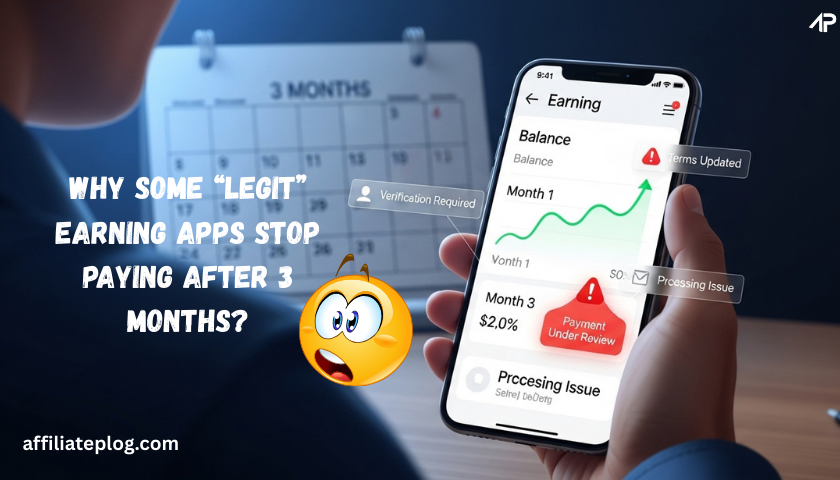
Why Some “Legit” Earning Apps Stop Paying After 3 Months: The Hidden Realities Behind Reward Platforms.
In the busy world of side gigs and passive income, in 2026, the popularity of earning apps had risen dramatically.
Various forms of platforms, such as surveys, gaming reward systems, bandwidth sharing, and cashback services, are among these, and they offer money-making opportunities through activities as easy as watching advertisements, completing offers, or sharing one’s leftover internet.
Many apps initially offer quick payouts, which hook users and generate viral referrals. Still, after about three months, a vexing situation arises: payments get delayed, thresholds go up, or cash-outs become impossible even with apps that appeared to be legitimate at first.
The situation is not always a straightforward case of cheating. There are a handful of apps that act like Ponzi schemes, dependent on the inflow of new users to give out rewards; however, the rest struggle due to real business difficulties.
Learning the reasons behind why legit earning apps stop paying after 3 months will give users the ability to recognize warning signs early, opt for viable choices, and safeguard their time and effort.
We are addressing reward app cash-out issues here and, hence, will reveal the financial matters, user habits, and platform tactics that cause this phenomenon.
No matter if you are busy with surveys or games, knowing these factors can enable you to achieve not only occasional earnings but also wise and long-lasting benefits in the digital economy, which is getting more and more saturated.
The Initial Charisma: Reason behind Generous Payouts by Legit Earning Apps at the Start
Usually, the majority of earning apps report reasonable budgets belonging to aggressive marketing and have high to very high rewards, low payout thresholds, and signup bonuses for fast user attraction.
The “honeymoon phase” attracts the users’ trust and momentum—users cash out early, review well, and bring their friends, facilitating the organic growth.
The first payouts are sometimes sustained by the choices of venture capitalism, the reserve of ad revenues, or the partnership with advertisers that desire user data acquisition and user engagement.
In the first couple of months, the situation fits the performing formula: high user acquisition justifies the giving out of high rewards, which is, in turn, the main reason for the flywheel effect of activity.
Users experience the app as being “legit,” thus they spend many hours doing the tasks, playing games, or making referrals on the app.
However, such massive use over a short period of time thoroughly predisposes apps to later difficulties due to inaccurate estimation of the real sustainable level of users’ engagement.
Not Having Sustainable Models of Business: When the Costs are Much Higher than the Revenue
Basically, many earning applications are characterized by a business style running on very low profits.
The sources of income can be ad revenue watched by users, commissions on the completion of offers (e.g., installing or signing up for an app), sales of data, or resale of bandwidth.
At the same time, if users are allowed to get rewarded, the profits of the business will be severely limited.
In any case, the growth of the community means the enlargement of obligations to the respective level of payouts.
The application encounters obstacles in the coverage of rewards in case of either a fall in the rates of advertising, which is a usual thing for digital markets with constant changes, or the fact that fraud concerns of partners have resulted in the reduction of their commissions.
The problem becomes more serious, and more often, there is the occurrence of high-earning users who can complete offers quite efficiently; thus, their consumption of funds is way higher than the value anticipated by an app.
The platform faces a monetary crisis at the moment of the third month, which is the point when the initial marketing promotional activity fades away, and the number of new signups declines.
Quite a few applications make a comeback by secretly adjusting: increasing the minimum cash-out threshold (e.g., from $5 to $20), diminishing the activity reward, or introducing “verification”, that is, as a rule, “causing delay.”
These modifications annoy devoted users, but the company buys time in such a way.
In the case of the app becoming an unprofitable product overall, the very consequence of this event could be the discontinuation of a product or the permanent withdrawal of payouts.
Fraud Detection and Policy Changes: Platform Protection Measures

Real apps spend a lot of money on anti-fraud security. If someone completes offers too fast, has multiple accounts, or takes advantage of glitches, a warning is triggered.
Platforms frequently postpone or refuse payments after reviews, especially once the initial period of gaining trust is over.
After about three months and accumulating data, apps start enforcing stricter rules. Offers that used to be credited immediately now require manual verification, or the entire account can be banned.
This is not necessarily a bad thing, most of the time, it is done so that abuse, which could lead to the platform’s bankruptcy or violation of advertiser terms are avoided.
However, it feels like a bait-and-switch for honest users, which is why trust goes down and they start to leave the platform.
Hidden Ponzi-Like Mechanisms: The Referral Hook
There are “legit” apps that use the heavily loaded referral system, where users get rewarded when their recruits perform activities.
This is a replica of Ponzi dynamics: the first people who join get to profit off the ones that come later, but you can’t keep growing forever.
When recruitment stops growing, usually after several months of going viral, contests for rewards dry up.
Apps that depend on always having new users will be the ones that fail, be it by paying out late or disappearing. Even if it wasn’t the intention, referral bonuses will exhaust the reserve quicker than core revenues can make them up.
Users Leaving and Market Being Saturated: The Normal Downturn
Applications that provide a way to earn money need lots of activity on their side, but after some time, most will lose interest.
At first, the work results in some kind of exciting discovery, but after a while, it seems boring, the rewards are too small compared to the time spent, and personal matters take over.
At the end of three months, churn goes up significantly—apps lose 70-80% of their user base. Fewer people being active means fewer ads are viewed or tasks completed, so the revenue falls drastically.
Consequently, platforms cut down on payouts while hoping to keep the top performers. This, in return contributes to another churn induction cycle: angry users leave, hence weakening funds further.
Legit Earning Apps Regulation and Platform Amendments: Factors Outside the Industry
App stores and payment gateways such as Google Play, Apple, or PayPal are introducing more rigorous regulations for reward applications, resulting in delisting or freezing of funds due to noncompliance (whether intentional or accidental).
Besides these changes, shifts in the economy, such as a decrease in advertisements during a downturn, cause the most impact around quarterly reviews.
Apps that appeared to be solid ones face compliance issues that might disrupt their operations temporarily or even justify a permanent shutdown.
Spotting the Red Flags: Ways to Ensure Your Safety
Some money-making apps never fall apart, but being cautious is advantageous. Check for various means of income (apart from ads), clear accounts of payouts, and small rather than overly hyped rewards.
The platforms with a proven history—like well-established survey websites or major cashback providers—are more likely to survive.
Experience with different apps, doing cash-outs regularly, and not spending too much time on untested newcomers will be the best things to do next.
Additionally, checking for recurring complaints about delays and choosing those with low minimum withdrawals and dependable processors must be prioritised.
Lessons from Real-life Users’ Experiences
Many stories follow this pattern: an energetic start leading to a payout amounting to $50-100 in a short period of time; later on, the pace gets slower and slower due to verification, fewer offers, or sudden changes in policy.
While it is the unscrupulous ones that receive most attention, these “overly legitimate” shutdowns consume more people’s time, and eventually, users get cynical not only about them but also about the whole category.
Conclusion: How to wisely navigate through the world of legit earning apps?
The question of “why do some Legit Earning Apps stop paying after 3 months?” is answered with a variety of reasons, including the ambition of the growth strategies, the fragility of the economics, and the harsh realities of the market.
These platforms are not the bad guys; a lot of them sincerely want to reward the users while they are building a profitable business.
However, the online reward space is more geared towards short-term hype rather than long-term stability, which results in the usual burnout at the three-month mark.
In 2026 and the following years, smart earners won’t depend on these apps for their income but rather see them as a source of fun and entertainment.
If you see where the pressure is coming from—unsustainable rewards, fraud prevention, and the need for constant growth—then you know how to get the most of it without overdoing it.
Concentrate on the methods that are tried and tested, diversify, take your money out as soon as possible, and always be doubtful when you hear big promises.
At the end of the day, the most sustainable “earning app” could very well be one that helps you gain real skills, like freelancing sites or content creation apps that allow you to turn temporary gigs into long-term opportunities.
Modestly use the legit earning Apps, keep your time safe, and be cautious of the digital promises that do not last. In the current world, the real way to get lasting gains is by being cautious and informed.

Chimezie Duru is a Lagos-based Digital Entrepreneur, Wikipedia Editor & Biography Writer, Affiliate Marketing Strategist, IT Consultant, and Blogging Coach with over 6 years of experience building and monetizing blogs in Nigeria’s digital space. He is the founder of InkRise Academy (InkRise Digital Concepts) and creator of the Ink To Income Masterclass. A 9-module blogging course for aspiring Nigerian & African writers and bloggers covering SEO, content strategy, and monetisation.
As the creator of AffiliatePlog.com, Chimezie writes from real experience on Wikipedia editing & biography writing, affiliate marketing, online earnings, and digital tools for Nigerian freelancers and content creators. He also works as a freelance Business and Data Analyst, IT Consultant & System Administrator, bringing an analytical edge to every content and business decision.