

Find out the Easier Way to Build Your First SaaS Without Writing a Single Line of Code in 2026
You don’t need to be a developer to build a successful SaaS business anymore. That’s not just hype, it’s reality in 2026. These days, solo founders with no coding skills at all are pulling in $10k, $50k, sometimes even over $100k every month, just by using no-code tools and clever integrations.
If you want in, here’s a clear, step-by-step roadmap you can use right now to build your first SaaS startup or company. Follow these numbered sections like a checklist, and you’ll be able to go from just an idea to landing real, paying customers in less than six weeks. Let’s dive in.
1. Validate the first SaaS idea before you build a single page (Week 1)

Never create first and then expect people to come. The quickest way to find out if your first SaaS idea is to create a product is to pre-sell your product. During an afternoon, you can easily create a one-page website explaining the problem, your solution, and with a big “Join the waitlist” or “Pre-order now” button.
People can use the button to give you money if you connect it to Stripe Payment Links. Putting a link on Indie Hackers, Reddit (r/SaaS, r/Entrepreneur), X, and Slack or Discord communities that are relevant is where you need to be. 7–10 dayisre what you should give yourself.
Your goal
At least 50 real email sign-ups OR $500–$1,000 in legitimate pre-orders. The moment you reach those figures, product-market fit is with you, and you have the green light to continue. In case you don’t, turn the messaging or move to a different idea. This one step alone has been instrumental in saving the time of thousands of founders who embarked on building their first SaaS.
-
Choose your no-code stack – the 2026 winning combination for building your first SaaS.
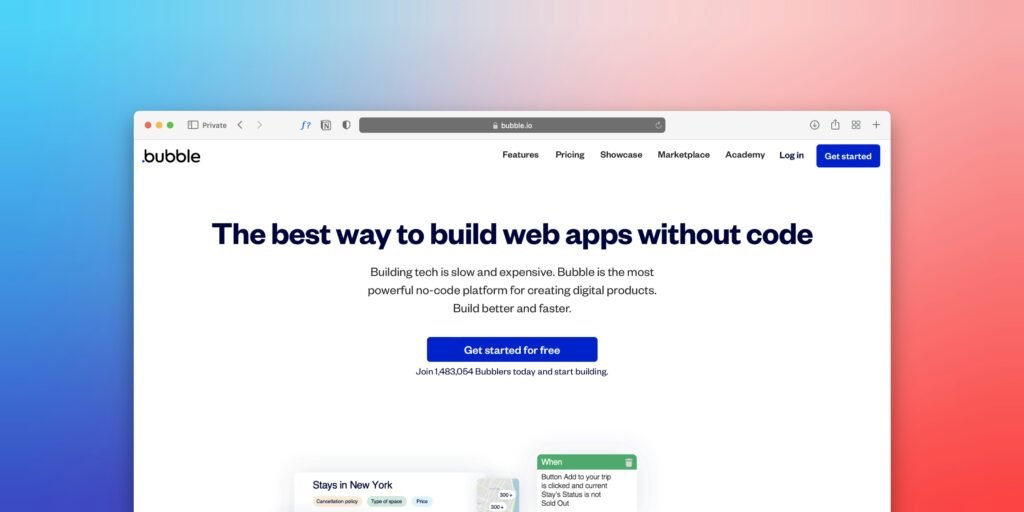
By 2026, the biggest part (more than 80%) of the profitable no-code SaaS projects will be developed on either Bubble.io or FlutterFlow. Bubble remains the most comprehensive (it covers everything from the database, workflows, payments, authentication, and on to other functions, and all through one visual editor).
However, if you aim to have a native mobile app or a pixel-perfect design, then FlutterFlow would be your choice.
Complete your builder with these ready-to-use services:
- Payments & subscriptions → Stripe (native integration)
- User login & customer portal → Memberstack or Outseta
- Email delivery → MailerSend, SendGrid, or Resend
- Analytics → June, Mixpanel, or PostHog
- Backend for heavy logic (only if needed later) → Xano or Supabase
When you are just starting, the total monthly expense would be around $40 to $80. The process of every integration is either one-click or drag-and-drop.
-
Build the Minimum Viable Product in 2 to 4 weeks.
New entrepreneurs usually do the following things in order inside Bubble or FlutterFlow:
First of all, take a UI template (For instance, the TemplateStack or the Bubble marketplace each has a plethora of affordable templates – $50–$200) so you can focus more on branding rather than fashioning a design from the ground up.
After that, changing the colors and logos to fit your branding and then importing it should be your next step.
After that, user authentication has to be set up; email magic links represent the modern standard, and they can be done in 10 minutes with Memberstack.
Subsequently, define your database entities (imagine them as Excel sheets saved in the cloud): Users, Workspaces, Projects, Subscriptions, etc.
Next, develop the main customer service workflow for which your customers will pay. Let’s say: a user enters a query → clicks “Generate” → your application sends the request to OpenAI or Claude → gets a response → saves it to the database → presents it in a user-friendly way. With no code, it’s as if you are literally drawing a flowchart.
At last, wire Stripe Checkout or Subscription billing and put up a neat billing portal where users are able to upgrade, downgrade, or cancel themselves.
How long does it typically take for a beginner to create a complete, launch-ready MVP in 2026? 14 to 28 days working part-time.
4. Add AI features in your first SaaS in minutes, not months
We used to think that only people with PhDs could add “smart” features to products, but that is no longer the case. Some examples: If you want blog posts to be self-generated, then just use OpenAI or Claude. If you want AI voiceovers, connect to ElevenLabs. If you want AI images or videos, then use Replicate, Fal.ai, or Kling.
In case you want to get data from the websites of your competitors, use Firecrawl or Browserless. Any big no-code platform has ready-to-use plugins, so adding AI literally means that you drag a box into your workflow and put an API key.
That is how founders spend less than $20–$50 per month on API usage for their first 500 to 1,000 customers.
-
Launch your first SaaS publicly and get your first 10–50 paying customers
What really works in the 2026 launch day playbook:
- Submit to Product Hunt (schedule it 2–3 weeks in advance)
- Write a detailed “launch post” on Indie Hackers with the story and the screenshots.
- Post a 60–90-second demo video on X, LinkedIn, and TikTok
- Provide a 40–50% lifetime or annual discount for the first 50–100 buyers
- If you want someone else to completely handle global VAT and tax compliance, then use Lemon Squeezy or Paddle.
Founders who execute this exact series of steps are the ones who usually see $2,000 to $10,000 in sales on their launch day just from waking up.
-
Iterate and scale your first SaaS without ever touching traditional code

After getting money, take customer feedback seriously. Use the same visual editor and add the features most requested by users. When you reach limitations of performance (generally somewhere between $5k–$15k MRR), you can move heavy workflows to Xano or Supabase with just a few clicks, still no coding involved.
Major 7-figure no-code first SaaS companies that you know may still be using Bubble or FlutterFlow for almost 90% of their stack.
Conclusion: You Can Build Your First SaaS in a Short Time
Your first SaaS is now weeks away, not years.
Not long ago, this seemed like a far-fetched dream, and now it is literally happening around us: teachers, marketers, designers, and even ex-baristas who all made up their minds to have recurring revenue and freedom.
They found a way to confirm demand within a week, created their minimum viable product through visual means in a month, launched, and went forward.
By 2026, the instruments will be robust, tested in battle, and at their lowest prices ever. The only thing left to be done is the decision to take the first step.
Choose one problem that hurts and that you know better than most, prove that people you don’t know will pay to solve it, and then let the no-code community do the heavy lifting for you. Your first paying customer is nearer than you imagine. Build it now.

Chimezie Duru is a Lagos-based Digital Entrepreneur, Wikipedia Editor & Biography Writer, Affiliate Marketing Strategist, IT Consultant, and Blogging Coach with over 6 years of experience building and monetizing blogs in Nigeria’s digital space. He is the founder of InkRise Academy (InkRise Digital Concepts) and creator of the Ink To Income Masterclass. A 9-module blogging course for aspiring Nigerian & African writers and bloggers covering SEO, content strategy, and monetisation.
As the creator of AffiliatePlog.com, Chimezie writes from real experience on Wikipedia editing & biography writing, affiliate marketing, online earnings, and digital tools for Nigerian freelancers and content creators. He also works as a freelance Business and Data Analyst, IT Consultant & System Administrator, bringing an analytical edge to every content and business decision.